

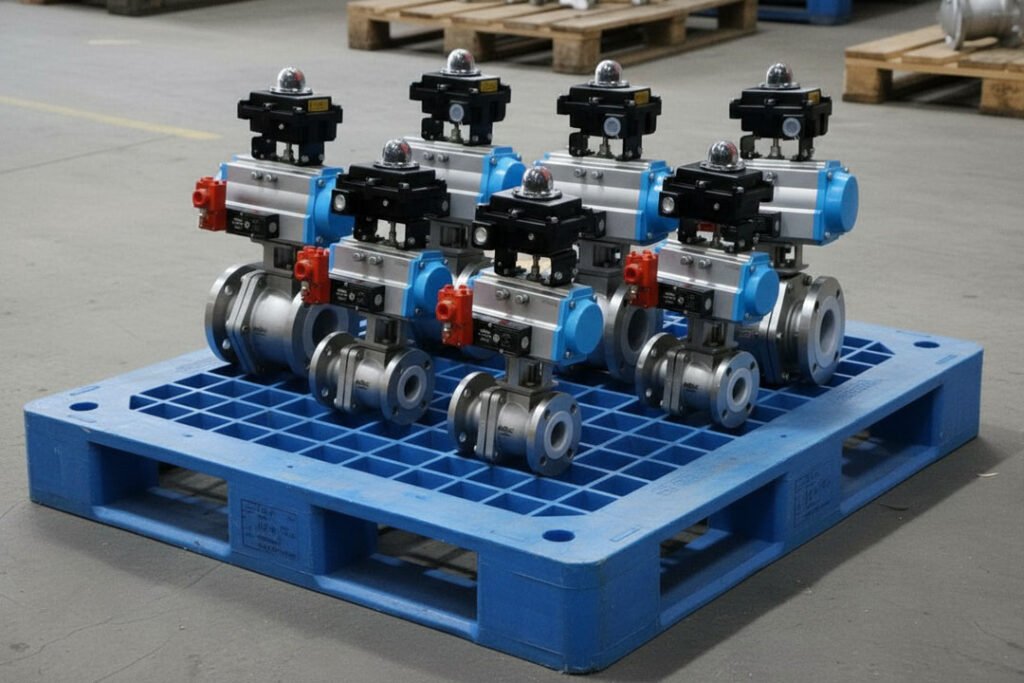
A ball valve is a flow control device that uses a hollow, perforated, and pivoting ball to regulate the flow of liquids or gases.
The valve opens when the ball’s hole aligns with the flow path and closes when rotated 90 degrees using a handle or actuator.
The handle stays inline when the valve is open and perpendicular when closed, offering easy visual confirmation.
Ball valves are known for their long service life, strong sealing ability, and durable performance. Their simple 90-degree operation,
resistance to pressure and temperature, and availability in materials like steel, brass, stainless steel, and plastics make them ideal
for a wide range of industrial and plumbing applications.
As a leading Ball Valve Manufacturer, Aironex Valves ensures high-quality, long-lasting, and leak-proof designs trusted across industries.
Types of Ball Valves
Common Functional Types
- Standard (Threaded) Ball Valves
- Flanged Ball Valves
- Vented Ball Valves
- Hydraulic Ball Valves
Material-Based Types
- Mild Steel Ball Valve
- Brass Ball Valve
- Forged Carbon Steel Ball Valve
- Iron Ball Valve
- Stainless Steel Ball Valve
- PP (Polypropylene) Ball Valve
Different Uses of Ball Valves
- Oil & Natural Gas Industry
- Manufacturing Units
- Chemical Processing & Storage
- Residential & Commercial Plumbing
Ball Valve Specifications
Choosing the right ball valve ensures proper flow control, safety, and durability.
Before selecting a valve, specifications such as size, pressure rating, temperature range, material compatibility, and connection type should be reviewed.
Every industrial setup has unique processes and material requirements. Selecting the proper ball valve ensures long operational life and system efficiency.
Aironex Valves provides customized specifications as a trusted Ball Valve Manufacturer.
Advantages of Ball Valves
- Compact and low-maintenance design
- No lubrication required
- Cost-effective
- Leak-proof service
- Quick open/close operation
- Multi-port design flexibility
Components of a Ball Valve
1. Body (Shell)
The main framework that houses all internal parts and acts as the first pressure boundary.
2. Bonnet
Attached to the body, the bonnet forms the second pressure boundary and protects internal components.
3. Trim
The trim includes the ball, seat, stem, and sleeves.
The ball rotates to control flow, the seat ensures sealing, and the stem connects the ball to the actuator.
4. Actuator
Handles, levers, gear systems, pneumatic, hydraulic, or electric actuators operate the valve.
5. Packing
Packing prevents leakage around the stem and ensures sealing integrity, typically made of PTFE or similar materials.
How Does a Ball Valve Work?
Ball valves use a hollow ball with a bore to start or stop flow:
- Open Position: The bore aligns with the pipeline, allowing full flow.
- Closed Position: Rotating the ball 90° blocks the flow completely.
Ball valves are ideal for full shut-off applications. Partial operation can cause wear, so they are not recommended for continuous throttling.
Depending on the number of seats and ports, ball valves may be unidirectional, bidirectional, or multi-directional (3-way, 4-way, 5-way).
Applications of Ball Valves
Due to their bubble-tight sealing and fast operation, ball valves are used in:
- Air, gas, and liquid flow control
- Underground, subsea, and cryogenic systems
- Drains and vents
- Feed water and cooling water systems
- Steam applications
- Oil refineries
- Gas processing plants
- Power plants
- Chemical and petrochemical industries
- Food & beverage (stainless steel valves)
Advantages and Disadvantages of Using Ball Valves
Advantages
- Bubble-tight sealing
- Fast open/close operation
- Compact and lightweight compared to gate valves
- Available with multiple ports
- Handles clean fluids and slurries
- Reliable in high-pressure and high-temperature conditions
- Easily automated
Disadvantages
- Not suitable for long-term throttling
- Particles in slurry/corrosive media may cause wear or leakage
Why Choose Aironex Valves?
As a trusted Ball Valve Manufacturer, Aironex Valves delivers:
- Precision-engineered valve designs
- High-quality materials
- Zero-leakage performance
- Custom manufacturing
- Long service life even in harsh industrial conditions